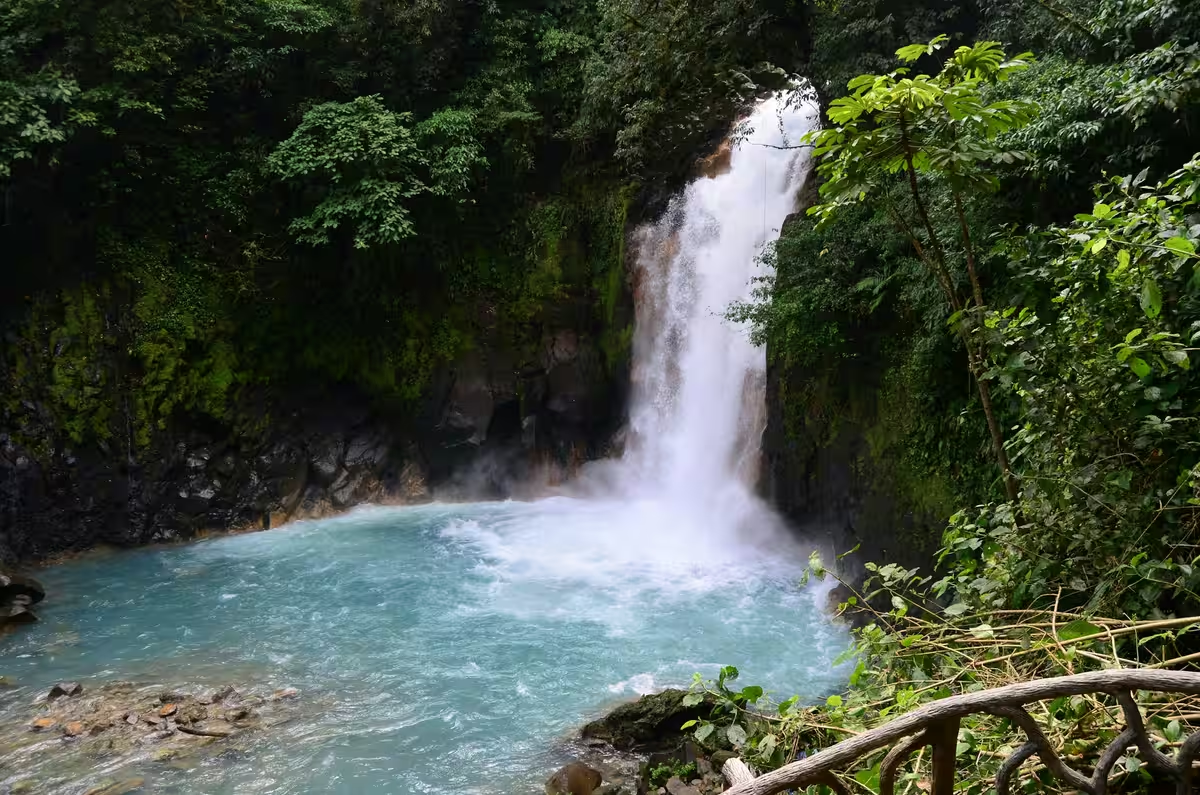
Río Celeste is the turquoise river inside Tenorio Volcano National Park, in northern Costa Rica between Upala and Guatuso. The park entrance is about 10 km from Bijagua. From San José it's roughly 3 hours via Cañas, and from Liberia about an hour and a half. The road is paved all the way to the entrance. We recommend a 4x4 because it rains often in this area, although in the dry season other vehicles also make the trip. Before you go, buy your ticket online: the park doesn't sell tickets at the gate.
Why the water is blue
There's no dye in the river. A 2013 study by the University of Costa Rica and OVSICORI-UNA showed that the color is a physical effect: the water carries very fine aluminosilicate particles that scatter light and reflect it back in blue tones. This happens at El Teñidero, where the Buenavista River meets the more acidic Quebrada Agria. As the two mix, the particles grow to just the right size to tint the water.
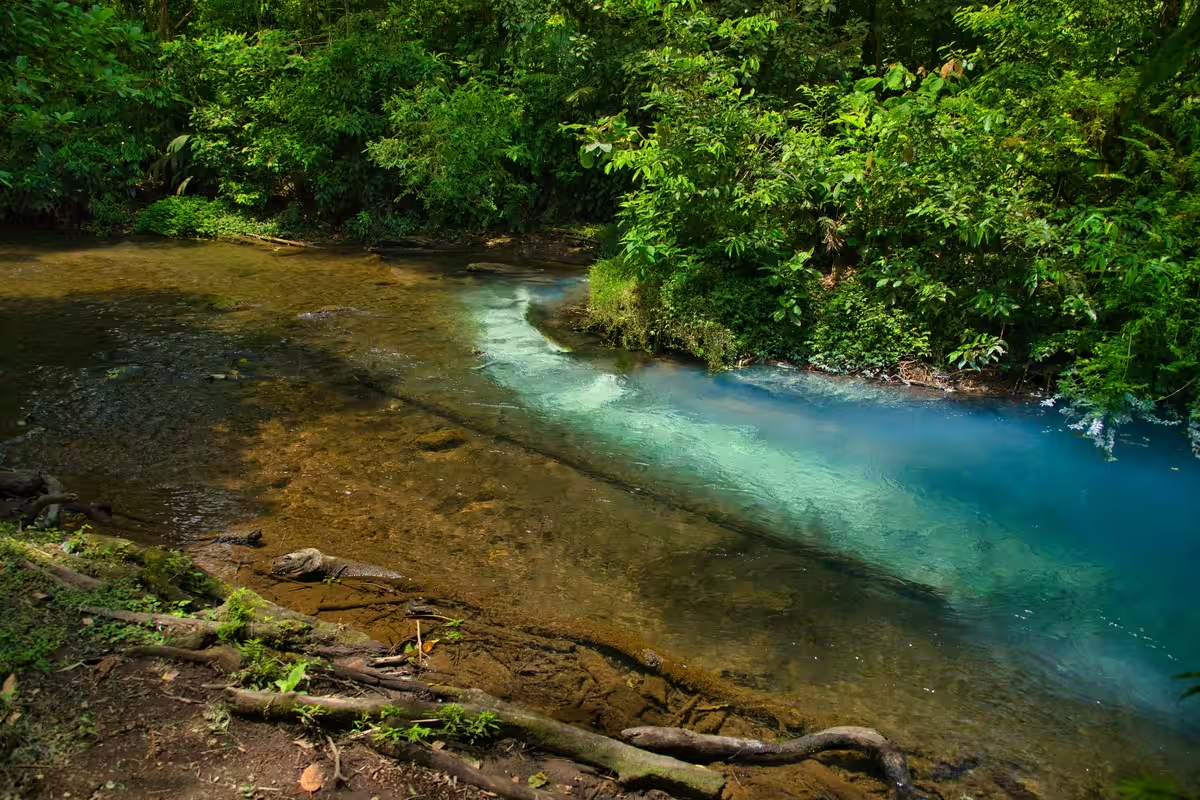
El Teñidero is at the end of the trail and is the only spot where you can see the color change happen: two streams of clear water meet and, from that point on, the river runs blue. The color depends on the river running clean. In January 2018, an earthquake swarm triggered landslides that washed sediment into the river, and it turned brown until the water ran clear again.
How to get there by car
From San José you have two options. The most direct is the Inter-American Highway (Route 1) to Cañas, then Route 6 toward Upala as far as Bijagua; Upala's tourism site estimates 2 hours 45 minutes to 3 hours. The other goes through San Ramón and La Fortuna to Katira on Route 4 and takes 4 to 4.5 hours. It only makes sense if you're combining the trip with Arenal Volcano. Either way, leave before 10 a.m.: fog tends to settle over the mountain passes in the afternoon.
From Liberia, take Route 1 south to Cañas and then Route 6 toward Bijagua. It's about an hour and a half, which makes Río Celeste a day trip if you fly into Liberia airport or are staying at the Guanacaste beaches. If you're planning that part of the trip, our Liberia guide is a good place to start.
From La Fortuna, the drive is 1.5 to 2 hours on Route 4, through San Rafael de Guatuso and Katira. Enterprise has an office in La Fortuna if you're starting from Arenal.
Bijagua or Katira: two ways into the same park
The park entrance is the El Pilón ranger station, where the trail starts, and you can reach it from two sides. From Bijagua, on Route 6, turn right onto the road locals call "Camino al Parque": it's 9.8 km, about 16 minutes. From Katira de Guatuso, on Route 4, turn left: it's 12.3 km, about 21 minutes. Katira also has hotels and tour operators that use the name "Río Celeste," so if you just type "Río Celeste" into your GPS, you may end up at one of them instead of the park. Set your destination to Tenorio Volcano National Park, El Pilón station.
Road conditions
Routes 1, 4 and 6 are paved, and both final approaches to the park, from Bijagua and from Katira, are also paved and in good condition. They are a different kind of road, though: narrow, with sharp curves, steep grades and speed bumps. The driveways to several rural lodges are still gravel.
According to SINAC, the area is influenced by the Caribbean climate and gets rain almost all year, about 3,500 mm annually. On wet pavement, those grades and curves call for driving slowly. Since the park closes at 4 p.m., plan to drive back in daylight.
Which vehicle to choose
At Enterprise we recommend a 4x4 for this trip. Since it rains here almost all year, you'll most likely find the road wet, and four-wheel drive gives you more control on the grades and curves of the last stretch. It's also the best choice if your lodge is on a gravel road.
In the dry season, from December to April, an SUV or a sedan also works on dry roads if you take the downhill sections carefully. If you're still deciding, our 4x4 vs SUV guide compares both in more detail.
Tickets, hours and park rules
SINAC information as of October 2026:
- Open every day. Entry is from 8:00 a.m. to 2:00 p.m., and you can stay until 4:00 p.m.
- Tickets are sold only at serviciosenlinea.sinac.go.cr. There is a limit of 1,200 visitors per day and 500 on the trail at once.
- Fees including VAT: ¢904 for nationals and residents (¢565 for children); US$13.56 for non-residents (US$5.65 for children). Senior nationals or residents and children under 2 enter free.
- There is drinking water and restrooms. Parking is private and paid separately.
- Entering the river is not allowed, nor are pets, drones, single-use plastics or alcoholic beverages.
Fees change over time. Check the amount on the SINAC site when you buy.
The trail: what you'll see
The Misterios del Tenorio trail is linear: 3 km out and 3 back, about 3 hours in total. It passes the waterfall, about 20 meters high; a lookout with views of three of the four cones of the Tenorio massif; the Laguna Azul, a small pool of intense color; the borbollones, cracks where hot volcanic gases escape; and it ends at El Teñidero. Depending on the season, some sections get muddy, so wear closed shoes.
You reach the waterfall down a staircase that has had full or partial closures in recent years due to rain and fallen trees. Before you go, check SINAC's notices to see how far down you can go that day.
Have any questions left?
These are the most common questions related to this topic. If you have a specific question, feel free to contact us: our team will be happy to help.
Not inside the park. SINAC rules don't allow entering the river anywhere along the trail, including the waterfall.
Through SINAC's online services site, serviciosenlinea.sinac.go.cr. At some parks, such as Tenorio Volcano (Río Celeste), it's the only way to buy them: tickets aren't sold at the entrance. Since there are daily visitor limits and hours change, check the park's page before you head out.
About 3 hours for the trail, plus the drive. From San José, it's easiest to leave early and spend the night in Bijagua or nearby; from Liberia or La Fortuna you can go and come back the same day.