Yes. Driving in Costa Rica is safe if you plan your trip during daylight, stay within the speed limits and check road conditions before you set out. The main highways are paved, and the license from your home country is valid for your whole stay as a tourist. What's different from other countries is the terrain: mountain roads with curves and fog, one-lane bridges, gravel rural roads and heavy rain between May and November.
What the roads are like
The highways out of San José are paved and several have tolls, and there is also asphalt all the way to destinations like Liberia, Río Celeste or the southern Caribbean. Away from the highways, many roads have two lanes, with curves and steep grades, and on mountain passes, like Braulio Carrillo on Route 32 to the Caribbean, fog and rain are common. Several destinations end on gravel: in Monteverde, for example, the final climb is gravel with tight curves, as our Monteverde guide explains.
In the rainy season, from May to November in most of the country, downpours open potholes and cause landslides that block roads. In 2026, Route 32 had closures in April, August and October. Before every long drive, check Waze or Google Maps.
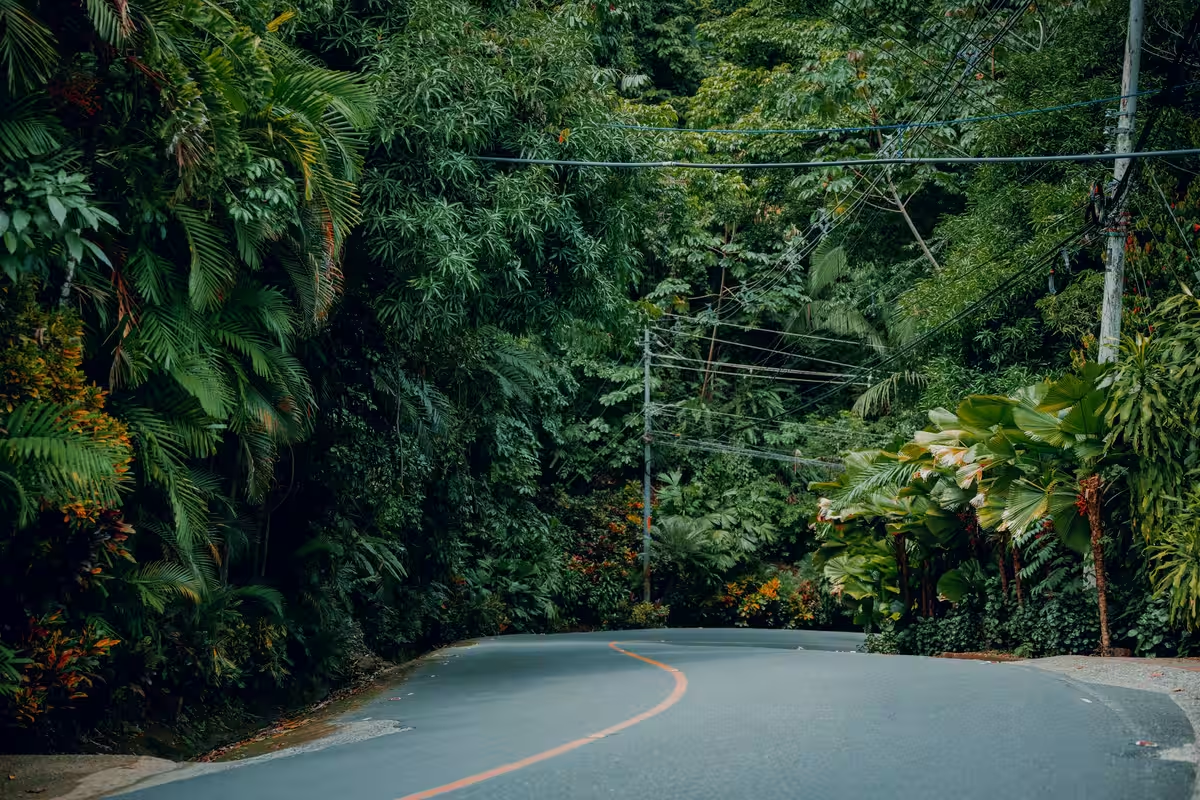
One-lane bridges are another thing you'll find here. One side has a "Ceda el paso" (yield) sign: if it's your side, stop and wait for the cars coming toward you to cross. Even when you have the right of way, go in slowly.
Drive during the day
In Costa Rica it gets dark between 5:10 and 6:00 p.m. all year round, according to the National Meteorological Institute's tables. With that schedule, a trip that starts in mid-afternoon ends at night. According to preliminary COSEVI data, 572 people died at the scene of traffic accidents in 2025, and the time slot with the most deaths was 6 p.m. to midnight. The ICT also recommends driving during the day whenever possible.
More than half of those deaths, 263, were motorcyclists. Check your mirrors before changing lanes or turning, because a motorcycle can come up on either side.
Traffic rules you should know
These are the rules from Traffic Law 9078 that matter most to visitors, with the fine amounts in effect since January 2026:
- License: you can drive with your home country's license for the same period that Immigration authorized your stay as a tourist. For countries in the first visa group, that period is up to 180 days.
- Speed: the limit is the one on the sign. Where there is no sign, it's 60 km/h, 50 km/h in dense urban areas, and 25 km/h in front of schools when students are present and in front of health centers. Going over 120 km/h carries a fine of ¢362,839, and above 150 km/h it's considered reckless driving, which is a crime.
- Seat belts: required for the driver and all passengers. The fine is ¢122,597.
- Children: children under 12 who are shorter than 1.45 m ride in the back seat, in a car seat or child restraint system.
- Cell phones: hands-free only. Holding your phone carries a fine of ¢122,597.
- Alcohol: the ¢362,839 fine applies from 0.50 grams of alcohol per liter of blood, or from 0.20 if you've had your license for less than three years. At higher levels, driving under the influence is a crime. The safest choice is not to drink anything if you're going to drive.
- Fines: they are paid at banks, never to the officer. If an officer asks you for money, call 9-1-1 to report it.
San José driving restriction
Monday through Friday, from 6 a.m. to 7 p.m., cars whose license plate ends in the two numbers assigned to that day can't drive in downtown San José. It doesn't apply on holidays or during some school vacations. Rental vehicles are among the exceptions the MOPT lists. If an officer stops you, show your rental contract, which must be in your name.
Tolls, addresses and navigation
Enterprise cars don't have an electronic toll device, so tolls are paid in cash, in colones or in US dollars with bills of US$20 or less. Carry coins and small bills so you don't hold up the line at the booth.
In much of the country, addresses don't use street names but landmarks ("200 meters north of the church"). That's why a map app is the way to go. Enter your destination before you start, while the car is parked.
Look after the car and your belongings
This is what the ICT recommends to anyone driving in the country:
- Don't leave valuables in the car or in sight: passports, computers, cameras or money.
- Use guarded public parking lots instead of leaving the car on the street, and keep doors and windows locked.
- Don't pick up hitchhikers, and don't stop on deserted or poorly lit roads.
- If you get a flat tire or the car breaks down, call Enterprise or the emergency number, which works without a local line, and don't accept help from strangers. The British government warns about a scam where someone punctures your tire and offers to help while an accomplice steals what's in the car.
If you have an accident, stay at the scene. Call the insurance company so the inspector comes out, a free service available 24 hours a day, and call 9-1-1 so a traffic officer comes. Then report the accident to Enterprise.
Car, bus or flight
The bus is the cheapest option, but San José has no central terminal: each company leaves from its own terminal, and trips take much longer than by car because of the stops. Shared shuttles pick you up at hotels and cost more than the bus. Domestic flights shorten long trips, and Enterprise has a Fly and Drive program that connects your flight with a vehicle at your destination.

A car makes sense when your itinerary combines several destinations or includes places public transportation doesn't reach. For paved roads, an SUV or a sedan is enough. If your plan includes gravel, mountains or the rainy season, a 4x4 is the better choice; our 4x4 vs SUV guide compares the two.
If you arrive at Juan Santamaría airport, the office is open 24 hours, and our San José arrival guide explains how to get onto the main routes. The documents you need to rent are in our requirements guide.
Have any questions left?
These are the most common questions related to this topic. If you have a specific question, feel free to contact us: our team will be happy to help.
Yes. The Traffic Law allows you to drive with a valid foreign license for the same period Immigration authorizes your stay as a tourist. To rent with Enterprise, the license must be a physical card, current, and issued at least one year ago. The other documents are in our rental requirements guide.
Stay at the scene and don't move the car if anyone is injured or if there's no agreement on what happened. Call the insurance company so they send the inspector, call 9-1-1 so a traffic officer comes, and then call Enterprise. If you need another vehicle while yours is being repaired, you can request a replacement car.
In cash. Enterprise cars don't have an electronic toll device, and the booths accept colones or US dollars in bills of US$20 or less.
No. Rental vehicles are among the exceptions to the license plate restriction, which applies Monday through Friday from 6 a.m. to 7 p.m. in downtown San José. Keep your rental contract handy in case an officer asks for it.
Not always. It depends on your itinerary: if you are sticking to paved roads, an SUV or even a sedan will do. A 4x4 is recommended if your plans include gravel or mountain roads, or if you are traveling during the rainy season (May to November).